News
OpenAI Splits GPT-5.6 Into Three Models, Accidentally Reveals Pro Versions
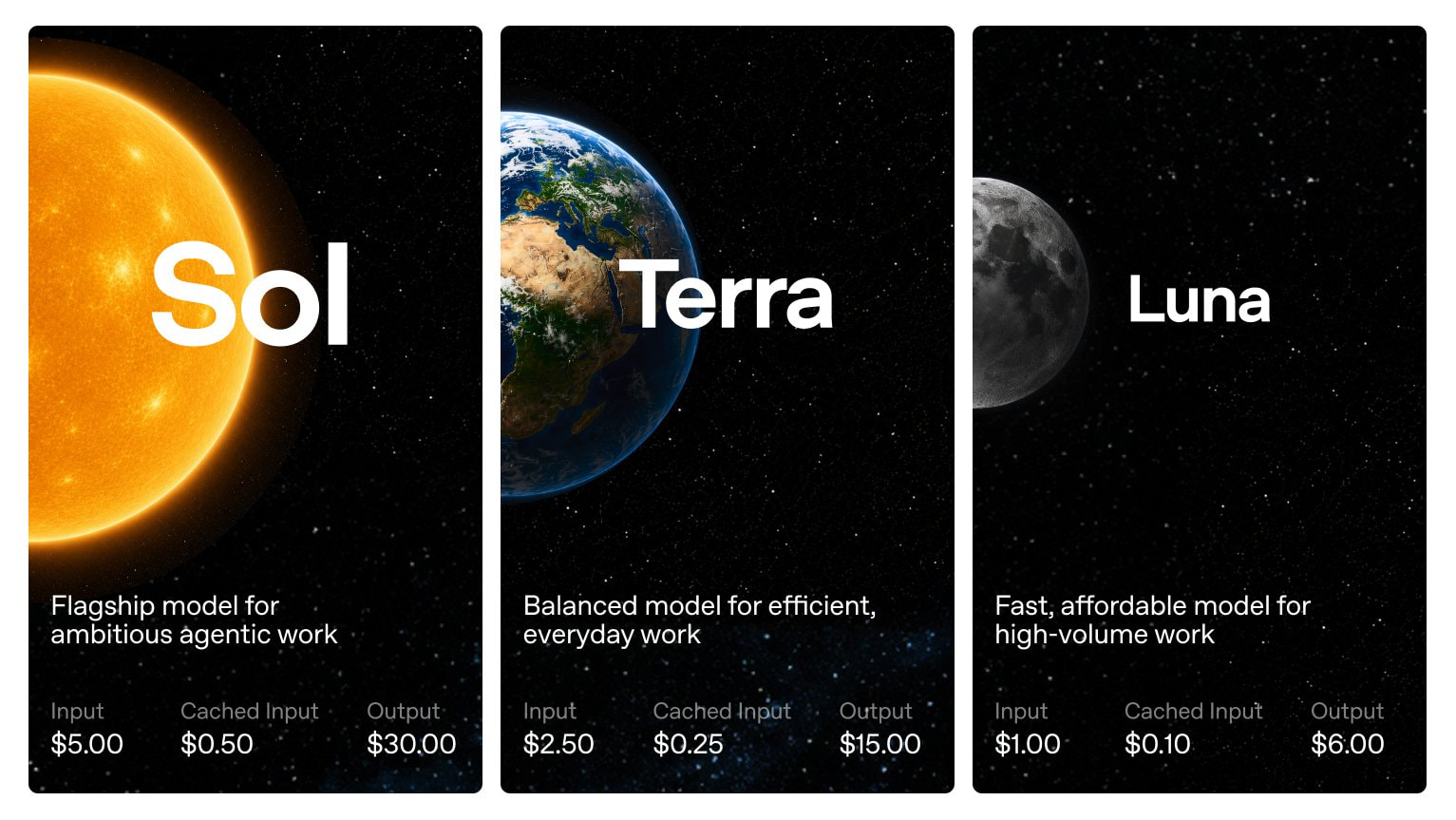
OpenAI has quietly given a small group of partners access to three variants of GPT-5.6, Sol, Terra and Luna, and a company research paper on genomics accidentally revealed the existence of additional Pro versions of each.
Contents
OpenAI has split its newest model into three separate variants sold under different names and prices, and a company research paper on AI applications in genomics accidentally revealed that three additional Pro versions are being developed behind the scenes. It's the clearest signal yet that OpenAI is abandoning the strategy of a single, universal top-tier model in favor of a broader lineup of products tailored to specific use cases and budgets.
Three Models Instead of One
The GPT-5.6 family reached a limited group of roughly twenty organizations in late June as part of pre-release testing. Sol is the flagship variant, built for the toughest tasks such as complex coding and cybersecurity research. Terra is meant to handle high-volume business use cases like customer service, internal tools and document analysis, with performance close to GPT-5.5 but at half the price. Luna is the cheapest and fastest variant, designed for everyday tasks such as summaries or draft text.
The pricing shows just how sharply OpenAI is segmenting its lineup. Sol costs $5 per million input tokens and $30 per million output tokens. Terra comes in at $2.5 and $15, while Luna runs $1 and $6. Sol also introduces two new reasoning features: a "max" mode that gives the model more time for deep analysis, and an "ultra" mode that launches coordinated subagents to split complex projects into smaller parts in parallel.
Government Review Before Launch
Before GPT-5.6 reached its first partners, OpenAI shared the model and its rollout plans with the US administration, as part of a voluntary process tied to a presidential executive order on AI cybersecurity. The company noted in its announcement, however, that it does not want this kind of government access to become standard practice going forward. Sol launched with the most extensive security package to date, including stronger protections against attempts to use the model for cyberattacks and repeated abuse. OpenAI said 700,000 GPU hours were spent testing Sol's resistance to jailbreaks and security vulnerabilities.
The Accidental Pro Leak
A few days after the launch of the three base variants, OpenAI published a research paper on the use of its models in genomics. A benchmark results table, however, included names the company had never officially announced: Luna Pro, Terra Pro and Sol Pro. It's the first official document in which OpenAI lists more than one Pro version at once, breaking with its previous practice of offering a single top-tier variant per model generation.
The numbers themselves are as interesting as the leak. Luna Pro scored 23.6 percent on the benchmark, 7.1 points higher than the standard Luna. Terra Pro scored 28.5 percent, 5.2 points above standard Terra. Sol Pro showed the smallest gain, at 31.5 percent, just 2.8 points above the regular Sol. The paper's authors noted that the higher a model sits in the lineup, the smaller the benefit from its Pro version, with Terra Pro effectively catching up to standard Sol, scoring 28.7 percent on another benchmark.
OpenAI has not disclosed pricing or token usage for the Pro variants, citing a lack of comparable billing data. It's also unclear whether or when this three-tier Pro structure will make it into ChatGPT for regular users, or whether it will remain an internal testing tool for now.
What It Means for Businesses and Developers
For businesses using OpenAI's API, splitting the model into three tiers effectively ends the simple choice between one model and its pricier version. Companies will now need to decide for themselves whether a given process, such as high-volume customer support or document analysis, requires Sol's power or whether the cheaper Terra will do. The approach echoes the strategy Anthropic has long used with its Claude family, where separate models serve different market segments by price and performance.
For Polish companies deploying automation built on GPT-5.6, this means costs will need to be calculated more precisely at the integration design stage, rather than picking a model once at the start of a project. The narrow access window, currently limited to around twenty organizations worldwide, also suggests that wider availability in Europe is likely still several weeks away before OpenAI announces a full rollout.